
Every property has one. The strip beside the shed, the shaded pocket behind the garage, the awkward corner where the lawn gives up and nothing quite grows. Most homeowners spend a decade mowing around it and apologizing for it. It is, as it happens, the single best place on the property to build a Japanese garden, because the qualities that make a corner useless for everything else are exactly the ones a contemplative space wants.
A Japanese garden is not a style you buy. It is a way of arranging a small amount of space so that it feels larger, calmer and older than it has any right to. That makes a forgotten corner not a compromise but an opportunity.
Why the Overlooked Corner Is the Right Site
Shade, enclosure and a sense of being tucked away are liabilities almost everywhere else in a yard and virtues here. The tradition was built for restraint rather than abundance, for filtered light rather than full sun, and for a boundary you can see all the way around. A corner already gives you two walls to work with, which means the whole space reads as a room the moment the planting goes in.
Scale is the other gift. A Japanese garden asks to be small. It is meant to be viewed from one or two fixed points rather than walked through end to end, which suits a nook far better than an open expanse. Working out those viewing points, and what the eye lands on from each of them, is the first thing we resolve during landscape design, long before anything is planted.
The Elements That Make a Space Read as a Garden
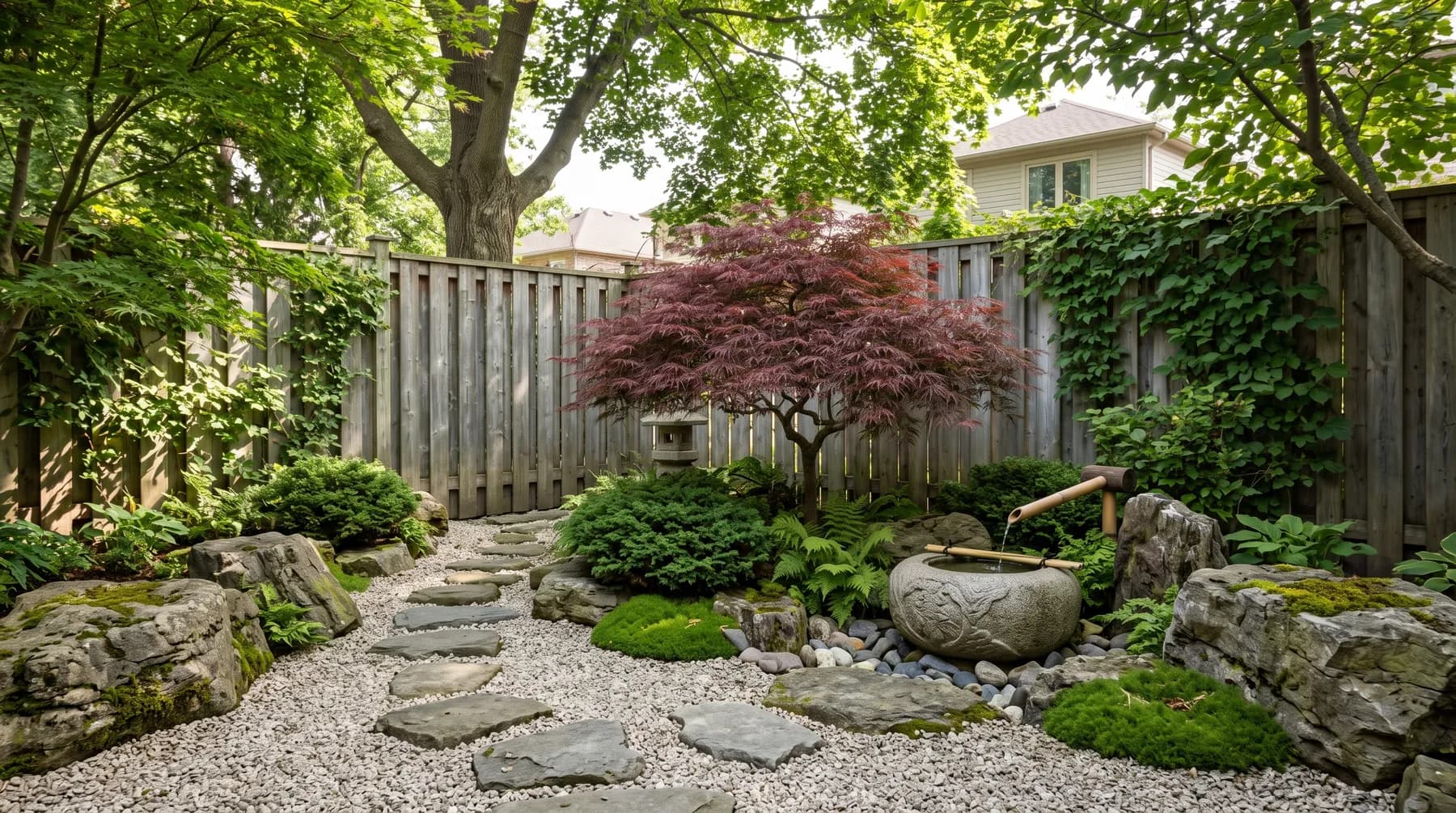
Four things do most of the work. Stone provides the bones, whether as a low arrangement of weathered boulders, a path of irregular stepping stones, or a dry streambed of raked gravel standing in for water that is never there. Water, real or implied, gives the space its stillness, and even a simple stone basin fed by a bamboo spout changes the entire feeling of a corner.
Then comes the planting, chosen for form and texture rather than for colour. A single Japanese maple, some low mounding evergreens, a drift of moss or a moss substitute, and perhaps a clipped shrub that reads as a hill in miniature. Restraint is the whole discipline here. The instinct to fill every gap is precisely the instinct to resist. The structural stonework and grade that hold all of this together are closer to backyard construction than to ordinary planting, and they need to be built to last.
Adapting the Tradition to a Southern Ontario Climate
The classic references come from a milder climate, so honest adaptation matters more than imitation. Japanese maples grow beautifully across the GTA but want shelter from harsh winter wind and afternoon scorch, which is another reason the enclosed corner suits them. True moss struggles in our dry summers, so a groundcover that reads the same, such as Irish moss or a low sedum, carries the effect without the heartbreak.
Evergreen structure is what keeps the garden alive from November to April, when a deciduous scheme would simply vanish. Dwarf conifers, mugo pine kept tight, and a careful hand with pruning give the space its year round shape. Choosing plants that thrive here rather than merely survive is the same principle that guides all our tree and shrub planting, and it is what separates a garden that endures from one that is replanted every second spring.
Living With a Japanese Garden Retreat
A well built Japanese garden is not low effort, but its effort is pleasant. Raking gravel, pinching back new growth and keeping the stone clear of leaf litter are tasks that take minutes and feel more like tending than like chores. That is rather the point. The space rewards regular small attention and quietly punishes neglect, which is a fair trade for a corner that used to give nothing back at all.
The deeper reward is what the corner becomes. A place to sit with a coffee before the house wakes up, a view from the kitchen window that settles the eye in every season, a small piece of the property that feels entirely separate from the rest of it. You can see how corners like these have been rebuilt across our completed projects throughout the region.
The forgotten corner was never the problem. It was simply waiting for the right idea. If you have a shaded, awkward pocket you have never known what to do with, that is very likely where your retreat belongs.